Cataracts in dogs are a concern for many owners; I understand your questions and want to give you a clear view of the costs in 2023 to help you make an informed decision 🐶🩺.
Quick summary:
I help you estimate and optimize your dog’s cataract surgery budget in 2023 so you can decide with complete peace of mind 🐶💶.
- 1 eye : €800–1,500 (approximate total €1,000–1,800), depending on the clinic and region.
- 2 eyes : €1,800–3,000; Until €3,500 with implant.
- Expected additional costs: implant +200–500 €/eye, tests 50–300 €, drugs 100–200 €, checks 50–100 €/visit.
- Insurance : Frequent support for 50–90%; verify limitations, exclusions, deficiencies and hereditary diseases.
- Quick Actions: Request to detailed quote (evaluation, anesthesia, implant, follow-up), contact your insurer before the procedure and anticipate post-operative visits 🩺.
Understanding cataracts in dogs
Before talking about prices, it is useful to remember what cataracts are and how they manifest themselves in animals.
Definition of cataract
Cataract corresponds to progressive opacification of the lensthe internal lens of the eye that focuses light. This clouding reduces light transmission and impairs vision.
It may be linked to age, a genetic abnormality, trauma or eye inflammation. Depending on the origin, progression and damage can range from partial loss of vision to complete blindness.
Common symptoms to watch out for
Visible signs include a whitish or grayish tint in the pupil, clumsiness, hesitation in movement, and decreased responsiveness to visual stimuli.
Sometimes we also observe secondary signs such as inflammation, behavioral changes or photophobia. An ophthalmological examination allows you to confirm the diagnosis and evaluate the severity.
Costs associated with the operation
Here are the amounts usually observed in 2023 according to professional literature and prices of specialized clinics.
Price per eye
To operate on a single eye, the most common range is between €800 and €1,500. This variation depends on the technique used (e.g. phacoemulsification), the surgeon’s experience and the preoperative tests required.
In some practices, the base fee can approach €1,000 per eye when evaluation, anesthesia and surgery are included in a standard package. Specialty clinics often charge more due to equipment and expertise.
Price for both eyes
When both eyes require surgery, clinics sometimes offer a flat rate price. In 2023, the average cost to operate on both eyes will be between €1,800 and €3,000.
If the surgery involves the placement of intraocular implants, packages may arrive €3,500. Savings are possible compared to two separate procedures, but surgical planning and recovery must be tailored to the dog’s case.
Details on additional costs
In addition to the base rate, several items increase the bill. Here are the most common and their orders of magnitude.
Cost of intraocular implants
The intraocular implant replaces the cloudy lens and can improve the quality of vision after surgery. Its use depends on the indication and the dog.
Adding an artificial lens usually increases the cost From 200 to 500 euros per eyedepending on the quality of the system and the brand. Some clinics include the cost in a package, others charge it separately.
Pre-operative visits and tests
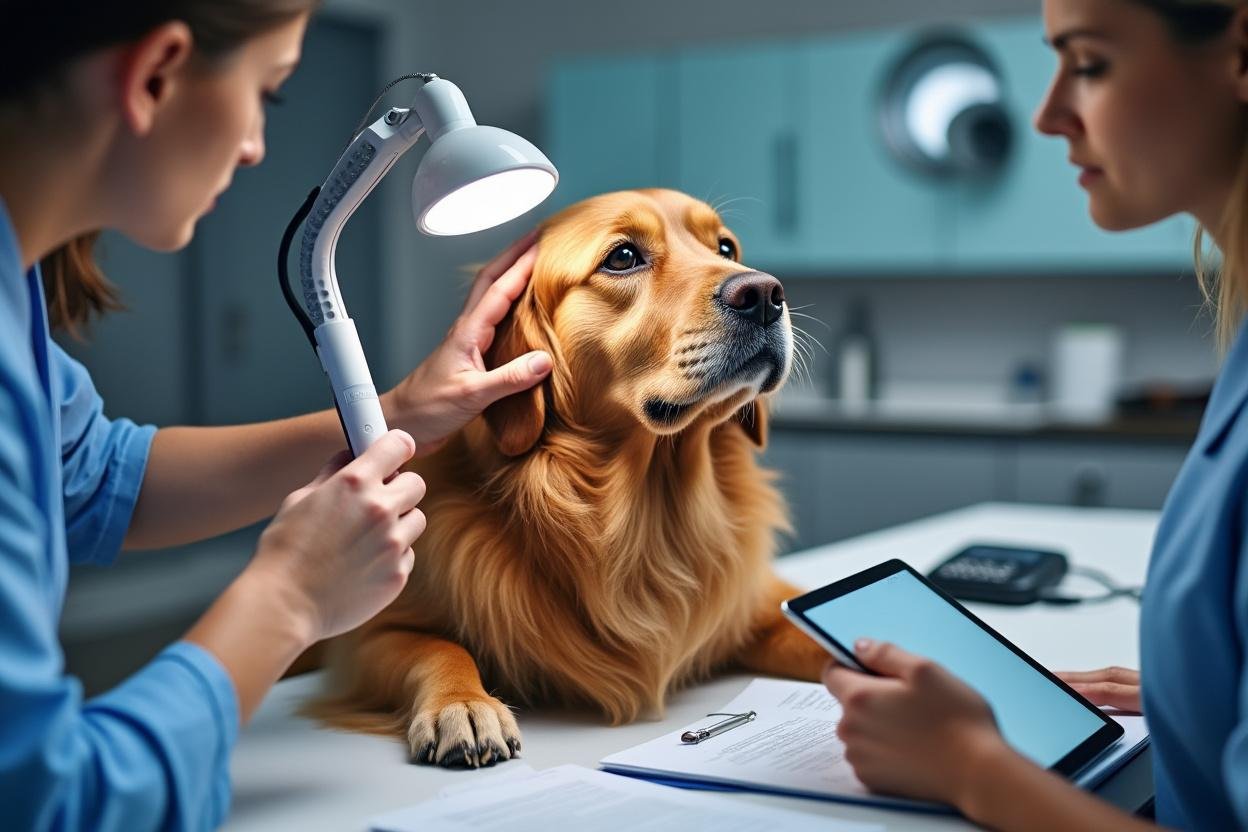
Before any surgery, a complete ophthalmological evaluation is necessary: clinical examination, intraocular pressure test, possibly ocular ultrasound and blood test for anesthesia.
These consultations and tests can cost between €50 and €300 depending on the depth of the evaluation and the need for further testing. Accurate documentation and anesthetic evaluation reduce intraoperative risks.
Postoperative care
Postoperative care is essential to prevent infection and inflammation and to optimize functional outcomes. They include eye drops, sometimes oral anti-inflammatories and controls.
Drugs generally represent from €100 to €200while check-ups are billed between €50 and €100 per session. Follow-up often extends for several weeks or a few months depending on the clinical response.
Factors influencing costs
Several parameters significantly modify the final price. Understanding these factors helps you anticipate actual spending.
Geographic location
Prices vary by region: urban areas and regions with high demand often have higher prices than rural areas. Cost of living and clinical expenses explain these differences.
In some regions it is also necessary to take into account the shortage of veterinary eye specialists, which can increase prices and lengthen waiting times.
Type of clinic
A general clinic that performs a basic procedure may offer a lower price than a referral center or a specialized clinic. Specialized centers invest in specific equipment and training, which is reflected in the price.
However, an intervention in an expert facility can reduce risks and improve visual prognosis, which represents an important added value to consider.
Size of the dog
Height and weight influence the duration of anesthesia, anesthetic consumption, and sometimes technical complexity. Very small or very large dogs may require adapted protocols.
In practice, this can result in a moderate cost difference, especially if specific tools or different consumables are needed.
Cataract severity
An advanced, calcified cataract or associated with other ocular lesions increases surgical complexity. Potential complications lead to additional procedures and therefore higher costs.
When surgery requires additional treatments (partial vitrectomy, uveitis management), prices increase accordingly. A precise preoperative evaluation allows us to estimate these eventualities.
Insurance reimbursement
Depending on the contract and the annual limit, pet health insurance can cover a significant portion of the costs.
Reimbursement levels and examples
Observed reimbursement rates generally vary between 50% and 90% of the refundable cost. The exact fee depends on the package chosen, any exclusions and waiting periods.
It is important to check whether the contract covers hereditary diseases, specialist interventions and whether there are limits per intervention or per year. A deductible or intervention percentage may apply.
What to check in the contract
See the list of reimbursed procedures, the annual maximum, exclusions related to age or pre-existing illnesses and waiting times. Some formulas reimburse more for interventions in specialized centers, others limit coverage to affiliated clinics.
Remember to keep detailed quotes and invoices – they are necessary to process refund requests. I advise you to contact your insurer before the surgery to clarify the terms 😊.
Estimated total cost of the operation
In summary, here is a realistic estimate of expected expenses in 2023, taking into account possible variations.
The following table provides a breakdown of costs in several common scenarios.
| After | Unit cost (€/eye) | Noticed |
|---|---|---|
| Surgery (basic rate) | 800 – 1 500 | It varies depending on the clinic and complexity |
| Intraocular implant | 200 – 500 | Optional, improves vision |
| Preoperative tests | 50 – 300 | Ophthalmological evaluation and anesthesia |
| Post-operative medications | 100 – 200 | Eye drops and anti-inflammatory treatments |
| Check-up visits | 50 – 100 (per visit) | Multiple visits are necessary |
| Approximate total cost (1 eye) | 1,000 – 1,800 | According to options and exams |
| Approximate total cost (2 eyes) | 1 800 – 3 500 | Possible packages, facilities included in some cases |
In summary, the general range for cataract surgery in 2023 is quite intermediate €1,000 and €3,000depending on whether one or both eyes are operated on, whether the implant is inserted and additional costs.
If your insurance covers part of the costs, the remainder you pay can be reduced to a reasonable amount. I remain at your disposal to analyze a quote and discuss therapeutic options suitable for your dog ❤️.
Latest posts

Adopt a small dog for free near Marignane: complete guide

Most expensive animal: what is its price? Discover the most expensive animals

How can I help my dog who barks when alone feel reassured?

Calming your cat’s heat with essential oils: what do you need to know?

I Regret Getting a Second Dog: What Should I Do?

How long can a rabbit go without drinking?

How does the Sarthe Animal Defense League protect hedgehogs?
Dog coughing as if he had something stuck: causes and solutions
How to easily recognize a carpenter wasp?